
By iSearchFrom. An AI-assisted synthesis of the linked research, not an original experiment.
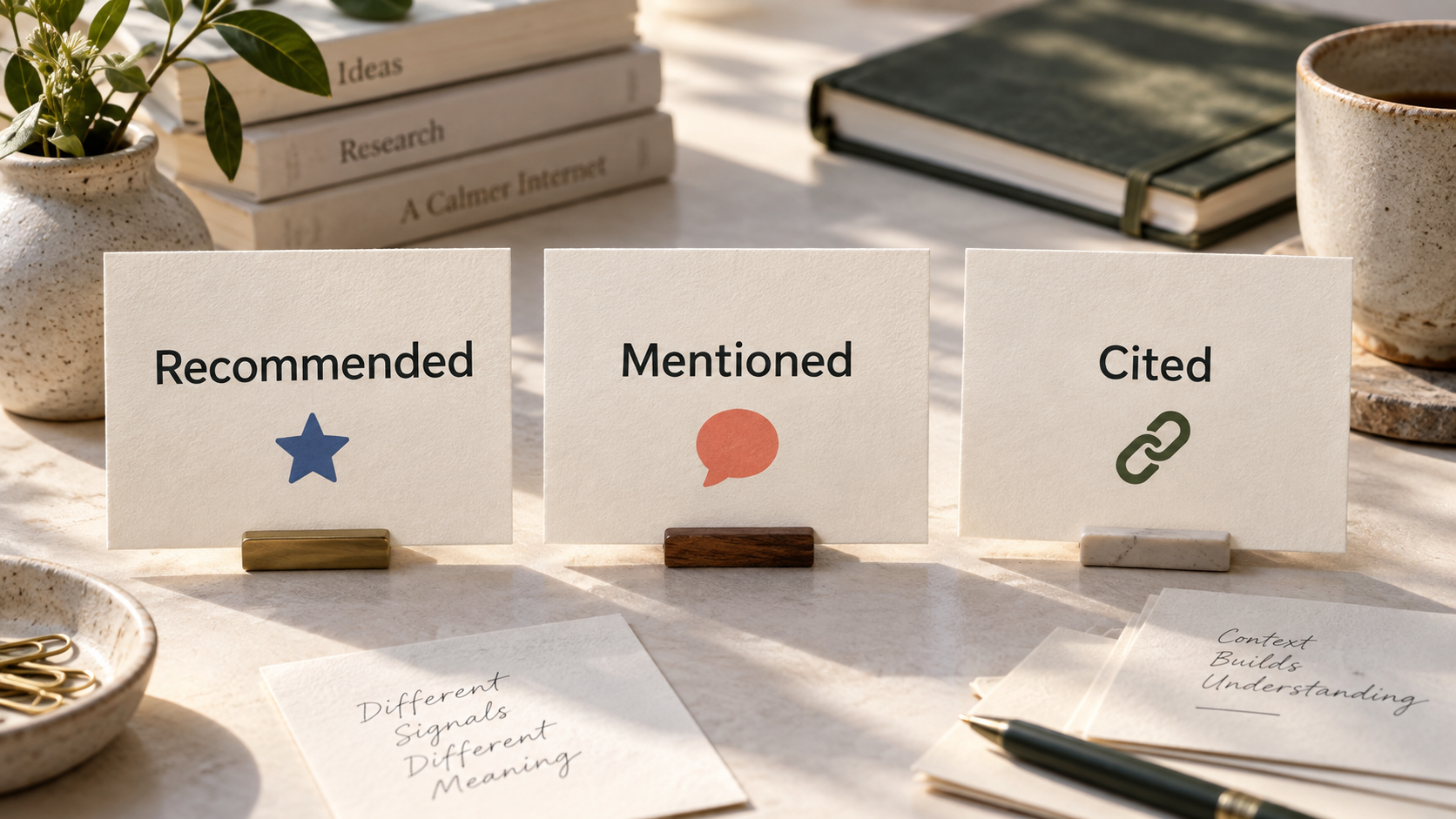
Cover: AI-generated conceptual artwork, not a product screenshot.
AI assistants appear to have favorite companies. But the company they recommend, the company they mention, and the company whose information they cite can be three different companies.
That distinction changes how an answer should be read. A name in a buying shortlist is not the same as a passing reference. A source link is not necessarily a product recommendation. And a confident answer is not a record of every alternative the system considered.
Four pieces of research help unpack the pattern. They point to platform-specific preferences and incomplete snapshots, but they do not establish that an assistant has evaluated an entire market, or that its apparent favorites are permanent.
One answer, three kinds of visibility
Consider a fictional example. You ask an assistant which scheduling tool suits a small design agency. It recommends Company A, mentions Company B as a more expensive alternative, and links to a workflow guide published by Company C.
All three companies appear in some sense. Only one gets the lead recommendation.
- Recommended: the answer presents the company as a suitable choice for the stated need. The wording and context matter, not just whether its name appears.
- Mentioned: the company is named in the answer. It might be an alternative, a comparison, background context, or an option the assistant advises against.
- Cited: a page associated with the company is linked as a source. The company may never be named in the answer’s prose.
These roles can overlap, but they are not interchangeable. A citation tells us which page the answer points to; it does not, by itself, reveal exactly how that page influenced generation or whether the assistant verified it correctly.
In the fictional example, Company A could receive the commercial benefit while Company C supplies the visible reference. Calling both outcomes “AI recommended us” would erase the difference that matters.
The source list changes with the platform
Ahrefs’ June 2025 analysis examined roughly 78.6 million results and prompts: 76.7 million Google AI Overviews, 957,000 ChatGPT prompts and 953,500 Perplexity prompts. It was not an evenly balanced sample of the three systems.
The leading domains differed. Wikipedia appeared prominently across all three. YouTube was among the leaders for Perplexity and AI Overviews but outside ChatGPT’s top ten. Reddit and Quora made the AI Overviews top ten, but not the other two lists.
That supports a limited, useful conclusion: different platforms surfaced different source mixes in that dataset. It is not a current league table of recommended companies. The observations date to 2025, concern source domains, and do not tell us whether a cited site’s products were endorsed.
A platform citing a review site frequently is not the same thing as a platform recommending that review site’s business. Source preference and product preference answer different questions.
Even “top recommended” needs a definition
A June 2026 arXiv preprint by Dmitrij Żatuchin analyzed 3,750 responses: 250 brand-free questions, three models and five repetitions. GPT-5.2, Gemini 3 Flash and Perplexity sonar-pro agreed on the leading brand for 104 of 250 questions, or 41.6%.
Importantly, its “top-recommended brand” was the brand with the highest mention count across the five runs, not a separate assessment of explicit endorsements. That is a useful visibility measure, but not identical to our definition of recommendation above.
The study tracked a predefined set of 50 brands. It also acknowledges that substring matching falsely detected the short brand name EY inside unrelated words. That makes the reported findings exploratory, not a clean market-wide benchmark.
The result is also less stark than “the models disagree about everything”: at least two of the three agreed in 91.6% of questions. The pattern suggests overlapping leaders with differences at the top, within the study’s limitations. It does not prove a universal winner-takes-all system.
A company can be cited and still go unnamed
Semrush’s June 2026 study recorded 3,981 domain appearances from 115 prompts across 14 countries and four AI search systems. Its breakdown was:
- 61.7%: cited without a brand mention (the “ghost citation” group).
- 13.2%: both cited and mentioned.
- 25.1%: mentioned without a citation.
The denominator matters. Although the article’s headline talks about citations, these three buckets divide all recorded domain appearances, including mention-only appearances. The 61.7% figure should not be described as the percentage of citations alone.
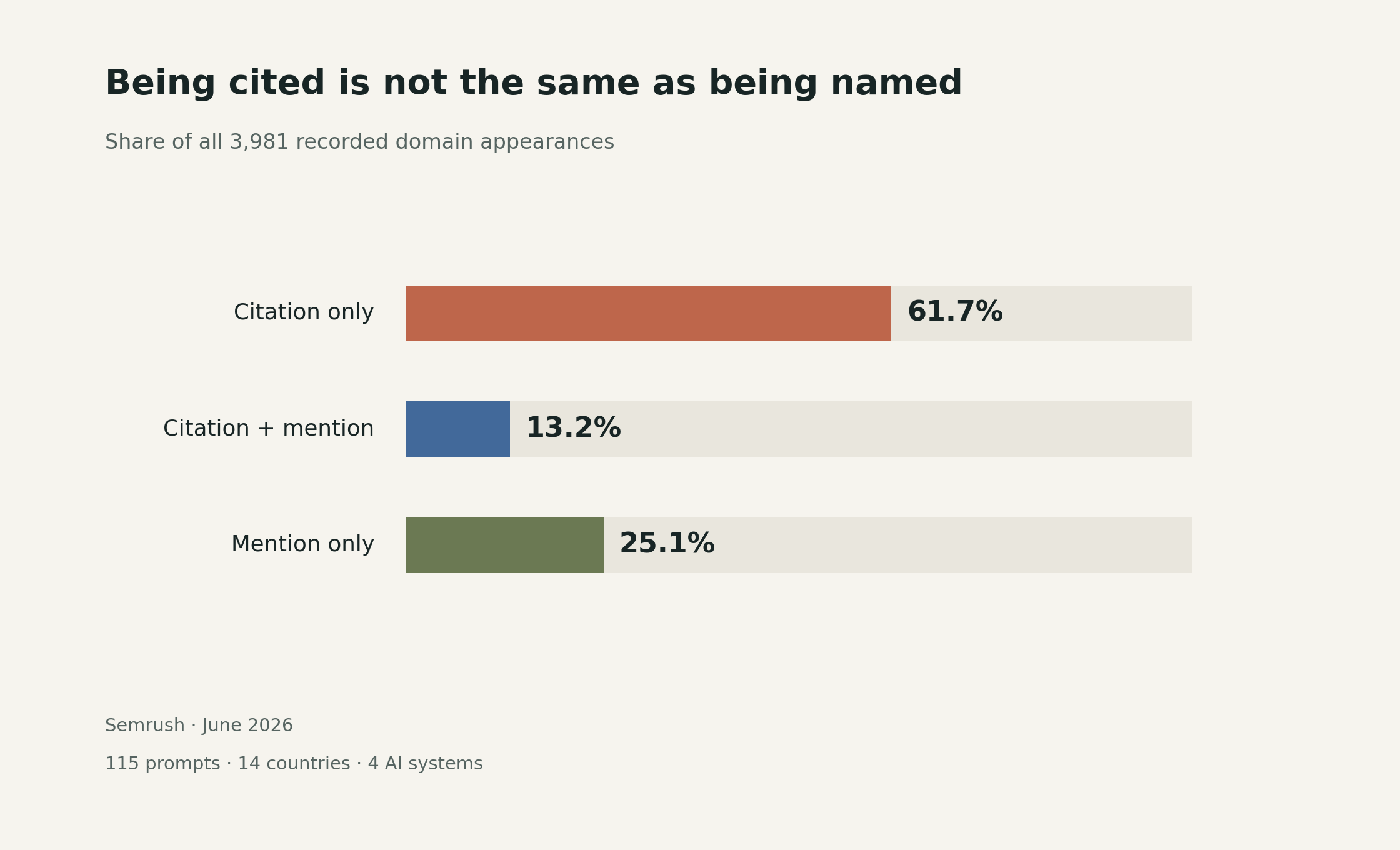
The practical distinction is straightforward: source-link visibility and being named in the prose are different outcomes. Neither measurement, by itself, establishes a recommendation, a click or a sale.
Ask again, and the list can grow
A September 2026 arXiv preprint, also by Żatuchin, investigated repeated identical buying questions. Its six-engine study collected 4,500 responses across 50 questions and 15 runs per engine.
It reports that one run captured 62–77% of the brands found across five runs. That is coverage of an observed five-run set, not of all companies in a market. Five runs are not a guarantee of completeness either.
The paper also found that searching only for a predefined roster of brands could make the results look more settled than an open-ended extraction did. If the measurement system can recognize only familiar names, unfamiliar names are missing before the analysis even begins.
This is a preprint from the same researcher as the earlier paper, not an independent replication. Its search-enabled and non-search configurations also differed, so those comparisons should not be treated as a controlled proof of what retrieval causes.
Still, the sampling lesson is valuable: a screenshot of one answer can document that answer. It cannot establish the full range of answers an assistant might produce.
What would a fairer check look like?
For AI visibility tracking, separate the observations rather than compressing everything into one score. For each answer, record which companies are recommended, which are merely named, and which domains are cited. Keep the actual wording so a negative mention cannot quietly become a positive result.
Then make the comparison inspectable:
- Keep the question fixed. Save the exact prompt and start a fresh conversation for each repeat. Test changed wording separately.
- Record the conditions. Note the date, platform, model when disclosed, language, location settings and whether web search was enabled.
- Repeat across runs and platforms. Report how often a company appears, not just the most flattering screenshot.
- Leave room for unexpected companies. Begin with an open list, then resolve aliases carefully. A tracker that only recognizes your chosen competitors cannot discover a new competitor.
- Keep uncertainty visible. Say what was sampled and what was not. Do not convert “absent in these answers” into “unknown to the model.”
This is a way to examine an output, not a recipe for making an assistant favor a brand. Nor should the four studies be pooled into one grand percentage: their dates, samples, systems and definitions differ.
A shortlist is not a market audit
“Favorite” is a convenient shorthand for a pattern in outputs, not evidence that a system has a preference in the human sense.
A familiar company appearing repeatedly could be relevant to the question. It could also be easier to retrieve, more prominent in available material, or better represented in the patterns the model has learned. These studies do not isolate which explanation produced any particular answer.
The unanswered question is not simply why a few names recur. It is what happened to the alternatives. Were they assessed and rejected, never retrieved, outside the measurement roster, or just absent from this run? A polished paragraph does not show that decision trail.
So when an AI assistant recommends a company, is it evaluating the whole market, or beginning with a familiar shortlist?